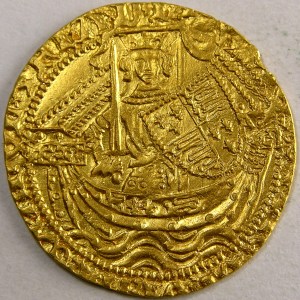
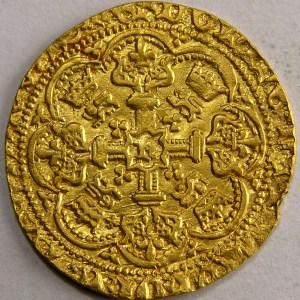
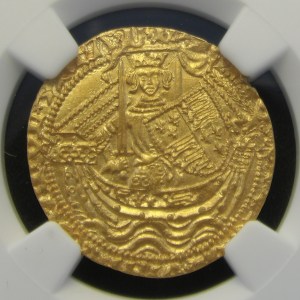
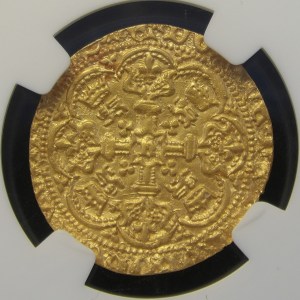


HENRY V/IV, 1/2 NOBLE, 1413. EXCESSIVELY RARE/ UNIQUE CLASS A MULE?
$23,800.00
S1748? Excessively rare, possibly unique mule of a Henry IV 1/2 noble and IMO the first and only known Class A half noble of Henry V. Obv: As Henry V class A nobles with annulet on rudder and short broad lettering with single saltire stops, quatrefoil above sail, twisted ropes 3/2. Ornaments -11-, Quatrefoils 3/2. REV: i.m. Pierced cross with pellet, slipped trefoil/quatrefoil in the 3rd quarter of reverse from a class B reverse die of Henry IV. At this time there is no known true Class A half noble obverse of Henry V, (although Stewartby speculates that some were minted). All previously known Henry V half nobles muled with a Henry IV reverse were mated with Class B Henry V obverses. This coin is similar to lot 62 from the Spink auction of the Isladulcie Collection of English Hammered Coins held on Jun 27, 2019. The cataloger believed that the half noble offered in lot 62 was a Class A obverse and makes his case in the quoted paragraph that follows. However, even that coin did NOT have the annulet on the rudder which is a characteristic only found on some class A Henry V nobles. See The Numismatic Chronicle (1966-), Seventh Series, Vol. 7 (1967), pp. 133-146, by Marion Archibald, The Fishpool Hoard, for a photo of a Henry V Class A noble (annulet on rudder) plate IX item 3.
“The addition of a quatrefoil ‘stop’ in the second quarter of the reverse is a standard feature throughout the Noble coinage of Henry V, and is visible across classes A (cf. BMC 1920.8.16.47) to C and beyond (cf. Schneider I, 214-15; 219-21, 225-36). It is however a highly unusual feature for the Half-Noble series, known only to this cataloguer from a similar example sold through this house in 2014 (cf. Spink 227, lot 533). That coin, from different dies, possessed lettering of Brooke’s N2a form which Harris, in accordance with Brooke, has attributed to his ‘B2’ phase for silver coinage.”
“However Stewartby has previously stated: “No half-noble with class A features has been found, and class B is represented only by two obverse dies…the earlier of these dies, without extra marks, is paired with a class P reverse. The other, only known with a reverse of class C (undamaged n), has a broken annulet on the ship’s side and a quatrefoil before henric (see lot 68). He adds: “the period of production of dies with class A lettering must have been extremely short and their usage not much longer. Although they entered the general stock of dies [an A/B mule silver Halfgroat is known], the interchange with both adjacent classes, the direct mules between classes P and B (in gold as well as silver) that miss out class A, and the absence of any Groat or Halfgroat of class A with cinquefoil added, all indicate that the class A die-sinker made only a minimal contribution to the recoinage. The sudden arrival and disappearance of his elegant and unusual font…could suggest the work of an expert foreign engraver whose services and some of his tools were not available for long.”
The take from the above discussion is that the cataloguer finds that the obverse of this half noble has many of the elements of a true Class A style as evidenced by the attributes belonging to Class A Henry V nobles especially the distinctive broad lettering and styling of particular letters, but is hesitant to come out fully to that conclusion, because no half nobles possessing all the Class A characteristics set down by Brooke are known. So although he calls it a class A type he puts this in parathesis. IMO the style of lettering differs enough from the other 1/2 noble Class B obverses so as to be seen as (if nothing else) an earlier, short lived creation. Whether one wants to label it a Class A 1/2 noble or not, it is certainly not like the other Class B 1/2 nobles (S1748) that are found muled with a Henry IV reverse. That then begs the question, what class does it belong to? If it is not a true Class B obverse why not Class A, what other option is there? There is no reason to believe that every element found on the Class A nobles would be duplicated by the same die sinker on the smaller half noble. The coin I have included has all the characteristics that the Isladulcie specimen has with one extra. The annulet on the rudder which IMO conclusively proves that this is a true class A 1/2 noble as ONLY a Henry V Class A noble has such a feature. In any event, should one want to regard this as another Class B mule, it would still be extremely rare since Class B half nobles are only known from two other obverse dies and number a total of only seven coins. Since there are no other known coins from this particular obverse die it is currently, UNIQUE.
Spinks 2024 Standard Catalogue of British Coins values a Class B mule 1/2 noble at $10000 in VF with only seven coins being known. The same value is set for a Henry V Class A noble of which at least a dozen exist. NGC clearly undergraded this coin, the coin is well struck, mint state, with full brilliance, but lacking a full flan due to some clipping. It is certainly the finest of its type in existence because right now it is the only one of its type. The most common type of Henry V nobles in mint state have reached prices of $24,000 or more, this unique specimen should be worth at least that. NGC MS63
NGC 2838198-009
Related products
-

AETHELHEARD, 798-805, 1D, A PEDIGREE COIN
$6,529.00 -

Aethelred II Unraed, 999-1002, 1d
$895.00 -
Australia Sovereign 1927P*
$1,315.00 -

Australia, 1874M, Sovereign, Ex Bentley Collection
$1,325.00